bSSFP multi-pool
This page illustrates using the Julia package BlochSim to calculate MRI signals for balanced steady-state free precession (bSSFP) pulse sequences.
This demo facilitates understanding bSSFP sequences, multi-compartment spins, and myelin water exchange.
This demo recreates Figure 3 from [1] and Figure 2 from [2].
References
[1] Hargreaves, B., Vasanawala, S., Pauly, J., & Nishimura, D. (2001). Characterization and reduction of the transient response in steady‐state MR imaging. MRM 46(1), 149-158.
[2] Murthy, N., Nielsen, J., Whitaker, S., Haskell, M., Swanson, S., Seiberlich, N., & Fessler, J. (2022). Quantifying myelin water exchange using optimized bSSFP sequences. Proc. Intl. Soc. Mag. Res. Med (#2068).
[3] Hinshaw, W. S. (1976). Image formation by nuclear magnetic resonance: the sensitive‐point method. J. of Applied Physics, 47(8), 3709-21.
[4] Whitaker, S. T., Nataraj, G., Nielsen, J. F., & Fessler, J. A. (2020). Myelin water fraction estimation using small‐tip fast recovery MRI. MRM 84(4), 1977-90.
This page comes from a single Julia file: bssfp-mc.jl.
You can access the source code for such Julia documentation using the 'Edit on GitHub' link in the top right. You can view the corresponding notebook in nbviewer here: bssfp-mc.ipynb, or open it in binder here: bssfp-mc.ipynb.
Setup
First we add the Julia packages that are need for this demo. Change false to true in the following code block if you are using any of the following packages for the first time.
if false
    import Pkg
    Pkg.add([
        "BlochSim"
        "LaTeXStrings"
        "LinearAlgebra"
        "MIRTjim"
        "Plots"
    ])
end
Tell this Julia session to use the following packages for this example. Run Pkg.add() in the preceding code block first, if needed.
using BlochSim: Spin, SpinMC, InstantaneousRF, RF, excite, freeprecess
using BlochSim: bssfp, bSSFPellipse, GAMMA, crb, real_imag, snr2sigma
using InteractiveUtils: versioninfo
using LaTeXStrings: latexstring
using LinearAlgebra: Diagonal, I, cond, diag, norm
using MIRTjim: prompt
using Plots: gui, plot, plot!, default
default(titlefontsize = 10, markerstrokecolor = :auto, label="", width = 1.5)
The following line is helpful when running this file as a script; this way it will prompt user to hit a key after each figure is displayed.
isinteractive() || prompt(:draw);Define some useful helper functions.
Hz_to_kHz(Δf_Hz) = Δf_Hz * 10^(-3) # convert frequencies in Hz to kHz
kHz_to_Hz(Δf_kHz) = Δf_kHz * 10^(3); # convert frequencies in kHz to Hz
The bSSFP pulse sequence in Figure 2 in [1] starts with a RF pulse, then
ais at time TEbis TR-TE later, right before next RF pulsecis immediately after the next RF pulsedis TE after that next RF pulse
We use this to generate Figure 3 in [1] in two different ways. The RF excitation is repeated periodically and, in steady-state, the magnetization at point a is the same as at point d.
Method 1: Use matrices
Use Equations 1 and 2 and Appendix A from [1]
Calculate the steady-state value at point d using the method from [1] using Equations 1 and 2 and Appendix A.
"""
    bssfp_matrix(Mz0, T1_ms, T2_ms, Δf_Hz, TR_ms, TE_ms, α_rad, θ_rf_rad=0)
)

Return steady-state magnetization signal value
at the echo time
for a bSSFP sequence
using method of
[Hargreaves et al., MRM 2001](https://doi.org/10.1002/mrm.1170).

# In tissue:
- `Mz0` initial condition for magnetization in the z-direction (constant)
- `T1_ms` MRI tissue parameter for T1 relaxation (ms)
- `T2_ms` MRI tissue parameter for T2 relaxation (ms)
- `Δf_Hz` off-resonance value (Hz) (default 0)

# In scan:
- `TR_ms` repetition time (ms)
- `TE_ms` echo time (ms)
- `α_rad` flip angle of RF pulse (radians)
- `θ_rf_rad` RF pulse phase (radians) (default 0)

# Out
- `signal` steady-state magnetization (as a complex number)
"""
function bssfp_matrix(
    Mz0, T1_ms, T2_ms, Δf_Hz,
    TR_ms, TE_ms, α_rad, θ_rf_rad::Number = 0,
)

    M0 = [0; 0; Mz0] # initial magnetization vector

    # rotation matrix for RF excitation about the y-axis
    if θ_rf_rad == 0 # y-axis
        R = [cos(α_rad) 0 sin(α_rad); 0 1 0; -sin(α_rad) 0 cos(α_rad)]
    elseif θ_rf_rad == -π/2 # x-axis
        R = [1 0 0; 0 cos(α_rad) sin(α_rad); 0 -sin(α_rad) cos(α_rad)]
    else
        throw("θ_rf_rad = $θ_rf_rad not implemented")
    end

    # free precession matrix
    Pz(angle) = [cos(angle) sin(angle) 0 ; -sin(angle) cos(angle) 0 ; 0 0 1]
    P(τ_ms) = Pz( 2π * Hz_to_kHz(Δf_Hz) * τ_ms ) # angle in radians

    # matrices for T1 and T2 relaxation over a time τ
    C(E1, E2) = [E2 0 0; 0 E2 0; 0 0 E1]
    C(τ_ms) = C(exp(-τ_ms / T1_ms), exp(-τ_ms / T2_ms))
    D(τ_ms) = (I - C(τ_ms)) * [0 ; 0 ; Mz0]

    # matrices for various values of τ
    P1 = P(TE_ms)
    P2 = P(TR_ms - TE_ms)
    C1 = C(TE_ms)
    C2 = C(TR_ms - TE_ms)
    d1 = D(TE_ms)
    d2 = D(TR_ms - TE_ms)

    # matrix A and vector b for steady-state calculation
    A = P1 * C1 * R * P2 * C2
    b = P1 * C1 * R * d2 + d1

    Mss = (I - A) \ b # steady-state magnetization

    return complex(Mss[1], Mss[2]) # return the complex signal
end;
Recreate Figure 3 from [1]
And compare Method 1 above with Method 2 (using bssfp in BlochSim)
TR_ms, TE_ms = 10, 5 # scan parameters
Mz0, T1_ms, T2_ms = 1, 400, 100 # tissue parameters

num_off_res_values = 401 # vector of off-resonance values
Δf_arr_Hz = kHz_to_Hz(range(-1, 1, num_off_res_values) / TR_ms) # 2 periods

flip_ang_arr_deg = [15, 30, 60, 90] # vector of flip angles

θ_rf_rad = 0; # y-axis rotation
Helper functions for broadcast:
bssfp_matrix(α_rad, Δf_Hz) = # method 1
    bssfp_matrix(
        Mz0, T1_ms, T2_ms, Δf_Hz,
        TR_ms, TE_ms, α_rad, θ_rf_rad,
    )
_bssfp(α_rad, Δf_Hz, Δϕ_rad) = # method 2
    bssfp(
        Mz0, T1_ms, T2_ms, Δf_Hz,
        TR_ms, TE_ms, Δϕ_rad, α_rad, θ_rf_rad,
    )
_bssfp_ellipse(α_rad, Δf_Hz, Δϕ_rad) = # method 3
    bssfp(bSSFPellipse,
        Mz0, T1_ms, T2_ms, Δf_Hz,
        TR_ms, TE_ms, Δϕ_rad, α_rad, θ_rf_rad,
    );
Call all bssfp versions for various flip angles and off-resonance values and verify that the calculations match.
sig_matrix = bssfp_matrix.(deg2rad.(flip_ang_arr_deg)', Δf_arr_Hz)
sig_blochsim = _bssfp.(deg2rad.(flip_ang_arr_deg)', Δf_arr_Hz, 0. #= Δϕ_rad =#)
@assert sig_matrix ≈ sig_blochsim # yes they match!

sig_ellipse = _bssfp_ellipse.(deg2rad.(flip_ang_arr_deg)', Δf_arr_Hz, 0. #= Δϕ_rad =#)
@assert sig_matrix ≈ sig_ellipse # yes they match!
Plot 1-pool signal magnitude and phase
label = reshape(map(a -> "α = $(a)°", flip_ang_arr_deg), 1, :) # row!
p_m = plot(Δf_arr_Hz, abs.(sig_blochsim); label,
    ylabel = "Signal Magnitude")
p_p = plot(Δf_arr_Hz, angle.(sig_blochsim); label,
    xlabel = "Resonant Frequency (Hz)",
    ylabel = "Signal Phase")
pmp = plot(p_m, p_p, layout=(2,1), plot_title = "bSSFP single pool",
    plot_titlefontsize = 13)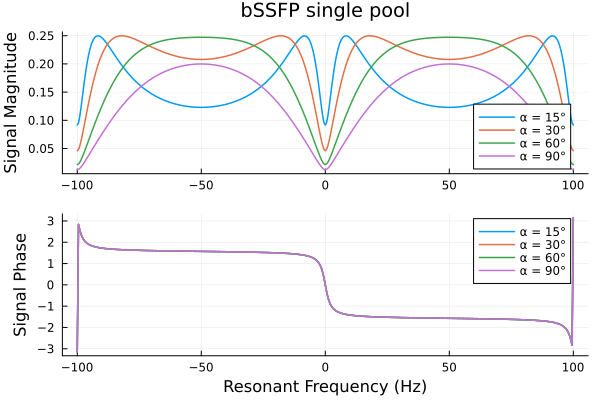
prompt()Explore T1 dependence of bSSFP signal model
T1_ms_arr = range(0.90, 1.1, 3) * T1_ms
α_deg = 20
sig_t1 = bssfp.(Mz0, T1_ms_arr', T2_ms, Δf_arr_Hz,
    TR_ms, TE_ms, 0. #= Δϕ_rad =#, deg2rad(α_deg))

label = reshape(map(t -> "T1 = $t ms", T1_ms_arr), 1, :) # row!
pt1_m = plot(Δf_arr_Hz, abs.(sig_t1); label,
    ylabel = "Signal Magnitude")
pt1_p = plot(Δf_arr_Hz, angle.(sig_t1); label,
    xlabel = "Resonant Frequency (Hz)",
    ylabel = "Signal Phase")
pt1 = plot(pt1_m, pt1_p, layout=(2,1), plot_title = "bSSFP single pool for T1",
    plot_titlefontsize = 13)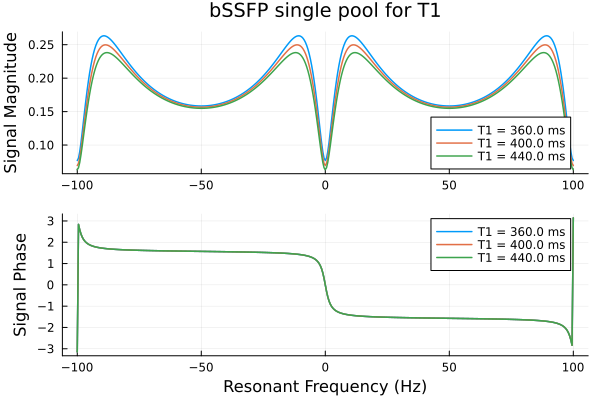
prompt()CRB for 1-pool bSSFP
Using arbitrary flip angles and phase cycling increments as scan "design"
kappa = 1 # also estimate the B1+ factor
M0_phase = π/3 # just to make it non-trivial
x = [M0_phase, Mz0, T1_ms, T2_ms, kappa] # unknowns
Δf_Hz = -7 # known

Δϕ_rad = (0:7)/8 * 2π
α_rad = [π/7, π/3]
tmp = Iterators.product(Δϕ_rad, α_rad)
design = (
  Δϕ_rad = vec(map(x->x[1], tmp)),
  α_rad = vec(map(x->x[2], tmp)),
)

signal_c = (x) -> cis(x[1] #= M0_phase =#) *
    bssfp.(x[2:end-1]..., Δf_Hz,
        TR_ms, TE_ms, design.Δϕ_rad, design.α_rad * x[end] #= kappa =#)
signal_ri(x) = real_imag(signal_c(x))


dB = 40 # SNR
σ = snr2sigma(dB, signal_c(x)) # noise level0.002052487336005278CRB, standard deviation, and coefficient of variation
crb_ri = crb(signal_ri, x, σ)
crb_std = sqrt.(diag(crb_ri))
crb_cv1 = round.(crb_std ./ x ; digits=3)
5-element Vector{Float64}:
0.002
0.089
0.183
0.027
0.083Multi-compartment spins and myelin water exchange
Generate Figure 2 from [2] using BlochSim. First define some useful helper functions. These functions put the parameters in the correct format for the multi-compartment spin object constructors.
"""
- in: `f_f` fast fraction (myelin fraction)
- out: `mwf_tuple` tuple with fast and slow fractions
"""
get_mwf_tuple(f_f) = (f_f, 1-f_f)


"""
    get_τ_tuple(τ_fs_ms, f_f)
# In:
- `τ_fs_ms` residence time for exchange from myelin to non-myelin water (ms)
- `f_f` fast fraction (myelin fraction)
# Out:
- `τ_tuple_ms` tuple with fast-to-slow and slow-to-fast residence times
"""
function get_τ_tuple(τ_fs_ms, f_f)
    τ_sf_ms = (1-f_f) * τ_fs_ms / f_f
    return (τ_fs_ms, τ_sf_ms)
end


"""
# In:
- `Δϕ_rad` RF phase cycling value (radians)
- `Δf0_Hz` off-resonance value (Hz)
- `Δf_myelin_Hz` # additional off-resonance value only experienced by myelin water (Hz)
- `TR_ms` repetition time (ms)
# Out:
- `Δf_tuple_Hz` tuple with off-resonance values for fast and slow compartments

[Hinshaw, J. Appl. Phys. 1976](https://doi.org/10.1063/1.323136).
"""
function get_Δf_tuple(Δϕ_rad, Δf0_Hz, Δf_myelin_Hz, TR_ms)

    # convert the RF phase cycling value to Hz from radians
    Δϕ_Hz = kHz_to_Hz((Δϕ_rad) / (2π*TR_ms))

    # subtract the RF phase cycling value from the off-resonance value
    Δf_RF_Hz = Δf0_Hz - Δϕ_Hz

    # add the myelin off-resonance for the myelin term
    Δf_myelin_RF_Hz = Δf_RF_Hz + Δf_myelin_Hz

    # create and return tuple for the spin object constructor
    Δf_tuple_Hz = (Δf_myelin_RF_Hz, Δf_RF_Hz)
    return Δf_tuple_Hz
end;
Define a function similar to Method 2 above, but for multi-compartment spin objects.
"""
    bssfp2(α_deg, TR_ms, TE_ms, spin, spin_no_rf_phase_fact)

Return steady-state magnetization signal value
at the echo time
for a phase-cycled bSSFP sequence
using BlochSim.

Ref: Murthy, N., Nielsen, J. F., Whitaker, S. T., Haskell, M. W.,
Swanson, S. D., Seiberlich, N., & Fessler, J. A. (2022).
Quantifying myelin water exchange using optimized bSSFP
sequences. In Proc. Intl. Soc. Mag. Res. Med (p. 2068). [2]

# In
- `α_deg` flip angle of RF pulse (degrees)
- `TR_ms` repetition time (ms)
- `TE_ms` echo time (ms)
- 'spin' multi-compartment spin object with RF phase cycling factor
- 'spin_no_rf_phase_fact' multi-compartment spin object without RF phase cycling factor

# Out
- `signal` steady-state magnetization (as a complex number)
"""
function bssfp2(
    α_deg::Number, TR_ms::Number, TE_ms::Number,
    spin::SpinMC, spin_no_rf_phase_fact::SpinMC,
)

    # convert flip angle α from degrees to radians
    α_rad = deg2rad(α_deg)

    # excite the spin and reshape R to be the correct dimensions for a SpinMC object
    (R,) = excite(spin, InstantaneousRF(α_rad))
    R = Matrix(R.A)
    R = kron(I(2),R)

    # precession/relaxation of the spin for TR
    (PC_TR_A, PC_TR_B) = freeprecess(spin, TR_ms)

    # precession/relaxation of the spin for TE
    # assume receiver modulates signal and uses the receiver phase as the RF phase
    (PC_TE_A, PE_TE_B) = freeprecess(spin_no_rf_phase_fact, TE_ms)

    # calculate A matrix and b vector
    A = Matrix(PC_TR_A) * R
    b = Vector(PC_TR_B)

    Mss = (I - A) \ b # steady-state just before tip down
    M = R * Mss # magnetization after tip-down

    # steady-state magnetization at the echo time
    M = Matrix(PC_TE_A) * M + Vector(PE_TE_B)

    return complex(M[1]+M[4], M[2]+M[5]) # return the complex signal
end;
Intermediate helper
function bssfp2(
    Mz0::Number,
    frac::NTuple{2, Number},
    T1_ms::NTuple{2, Number},
    T2_ms::NTuple{2, Number},
    Δf_Hz::NTuple{2, Number},
    Δf_no_rf_phase_Hz::NTuple{2, Number},
    τ_ms::NTuple{2, Number},
    α_deg::Number, TR_ms::Number, TE_ms::Number,
)

    # create spin (with and without RF phase-cycling factor)
    spin = SpinMC(Mz0, frac, T1_ms, T2_ms, Δf_Hz, τ_ms)
    spin_no_rf_phase = SpinMC(Mz0, frac, T1_ms, T2_ms, Δf_no_rf_phase_Hz, τ_ms)

    return bssfp2(α_deg, TR_ms, TE_ms, spin, spin_no_rf_phase)
end;


"""
    bssfp2(...)
Version with scalar arguments (convenient for autodiff)
"""
function bssfp2(
    M0_phase::Number, # radians
    Mz0::Number,
    f_f::Number,
    T1_f_ms::Number,
    T1_s_ms::Number,
    T2_f_ms::Number,
    T2_s_ms::Number,
    τ_fs_ms::Number,
    Δff_Hz::Number, # fast component frequency shift
    # system parameter (sometimes known):
    Δf0_Hz::Number, # B0 off resonance
    # scan parameters (always known):
    α_deg::Number, TR_ms::Number, TE_ms::Number,
    Δϕ_deg::Number, # RF phase cycling value (degrees)
)

    τ_tuple_ms = get_τ_tuple(τ_fs_ms, f_f) # fast-to-slow and slow-to-fast residence times

    # tuple of values incorporating off-resonance and RF phase cycling for both compartments
    Δϕ_rad = deg2rad(Δϕ_deg)
    Δf_tuple_Hz = get_Δf_tuple(Δϕ_rad, Δf0_Hz, Δff_Hz, TR_ms)
    Δf_tuple_Hz_no_rf_phase = get_Δf_tuple(0, Δf0_Hz, Δff_Hz, TR_ms)

    return cis(M0_phase) * bssfp2(
     Mz0,
     (f_f, 1 - f_f),
     (T1_f_ms, T1_s_ms),
     (T2_f_ms, T2_s_ms),
     Δf_tuple_Hz,
     Δf_tuple_Hz_no_rf_phase,
     τ_tuple_ms,
     α_deg, TR_ms, TE_ms,
    )
end;
Define variables to be used in the following plots. Values taken from [2] and [4].
Mz0 = 0.77 # initial condition for longitudinal magnetization (constant)
Δf_myelin_Hz = 5.0 # frequency shift of myelin water
f_f = 0.15; # myelin water fraction (MWF), fast fraction

# T1 and T2 values
T1_f_ms = 400 # T1 for fast-relaxing, myelin water compartment
T1_s_ms = 832 # T1 for slow-relaxing, non-myelin water compartment

T2_f_ms = 20 # T2 for fast-relaxing, myelin water compartment
T2_s_ms = 80 # T2 for slow-relaxing, non-myelin water compartment

TR_ms, TE_ms = 20, 4; # scan parameters (note: TE = TR/2 would be more logical)
Generate plots similar to Figure 3 from [1] but with three different RF phase cycling factor values: (0, 90, and 180 degrees).
For this example, choose one exchange rate:
τ_fs = 100.0 # this will be varied in the next plot

flip_ang_arr_deg = [10, 40] # flip angles

Δϕ_arr_deg = [0, 90, 180] # RF phase cycling value (degrees)

# vector of off-resonance values
num_samples = 401 # number of samples (resonant frequencies)
Δf_arr_Hz = kHz_to_Hz(range(-1, 1, num_samples) / TR_ms);
Broadcast via map using helper functions
bssfp_mc(Δf0_Hz::Number, Δϕ_deg::Number, α_deg::Number, τ_fs::Number) =
    bssfp2(0 #= phase =#, Mz0, f_f, T1_f_ms, T1_s_ms, T2_f_ms, T2_s_ms, τ_fs,
        Δf_myelin_Hz, Δf0_Hz, α_deg, TR_ms, TE_ms, Δϕ_deg)

tmp = Iterators.product(Δf_arr_Hz, Δϕ_arr_deg, flip_ang_arr_deg)
bssfp_mc(t3::NTuple{3, Any}) = bssfp_mc(t3..., τ_fs) # (Δf_Hz, Δϕ_deg, α_deg)
signal_mc = map(bssfp_mc, tmp);
Plot 2-pool signals
pmcm = plot(ylabel = "Signal Magnitude")
pmcp = plot( ylabel = "Signal Phase", xlabel = "Resonant Frequency (Hz)")
for i in 1:size(signal_mc,3), j in 1:size(signal_mc,2)
    label2 = "α = $(flip_ang_arr_deg[i])°, Δϕ = $(Δϕ_arr_deg[j])°"
    tmp2 = signal_mc[:,j,i]
    plot!(pmcm, Δf_arr_Hz, abs.(tmp2))
    plot!(pmcp, Δf_arr_Hz, angle.(tmp2); label = label2)
end

p2 = plot(pmcm, pmcp, layout = (2,1), titlefontsize = 12,
    plot_title = "bSSFP 2-pool magnitude and phase")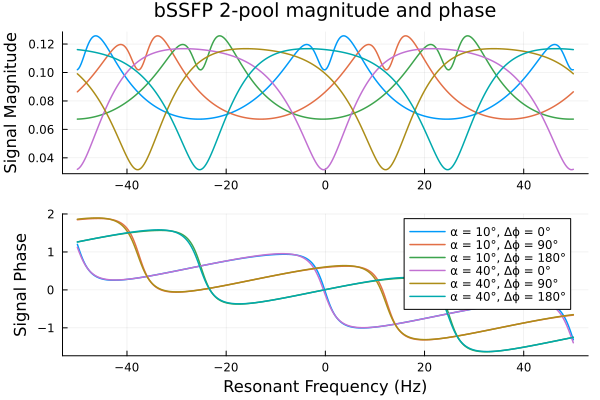
prompt()Recreate Figure 2 (magnitude plot) from [2]
and also plot the phase.
Δf_Hz = 0.0 # set off-resonance to zero for this plot
tau_arr_ms = [250, 150, 50] # array of exchange values
tau_arr_marker = [:circle, :star5, :utriangle]

Δϕ_design_deg = ( # designed RF phase cycling increments
 [-176.4, -159.5, -142.1, -124.4, -107.6, -90.54, -73.62, -56.13, -39.41, -22.52, -5.272, 11.63, 28.93, 45.76, 63.08, 79.91, 96.97, 113.9, 131.3, 148.5, 166.1],
 [-168.8, -150.3, -130.1, -111.5, -93.19, -74.18, -54.68 , -37.15, -18.01, 1.342, 18.82, 38.64, 57.88, 76.48, 95.2, 113.3, 133.3, 153.1, 172.1],
)

α_arr_deg = [10.0, 40.0] # flip angles for plot
α_design_deg = [
  fill(α_arr_deg[1], length(Δϕ_design_deg[1]));
  fill(α_arr_deg[2], length(Δϕ_design_deg[2]))
]
design = (Δϕ_deg = vcat(Δϕ_design_deg...), α_deg = α_design_deg)
num_scans = length(design.Δϕ_deg) # number of different scans = 40

tmp = (τ_fs) -> (Δϕ_deg, α_deg) -> bssfp_mc(Δf_Hz, Δϕ_deg, α_deg, τ_fs)
bssfp_signal(τ_fs) = map(splat(tmp(τ_fs)), zip(design...))

signal = bssfp_signal.(tau_arr_ms)

# Plot
scan_idx = 1:num_scans
p_m = plot(title="Signal Magnitude vs. Scan Index", ylabel = "Signal Magnitude")
p_p = plot(title="Signal Phase vs. Scan Index", ylabel = "Signal Phase")
for j = 1:length(signal) # iterate over exchange values
    markershape = tau_arr_marker[j]
    local label = latexstring("\$τ_{\\mathrm{fs}}\$ = $(tau_arr_ms[j]) ms")
    plot!(p_m, scan_idx, abs.(signal[j]), linewidth=0; markershape, label)
    plot!(p_p, scan_idx, angle.(signal[j]), linewidth=0; markershape, label)
end
p3 = plot(p_m, p_p, layout = (2,1), xlabel = "Scan Index")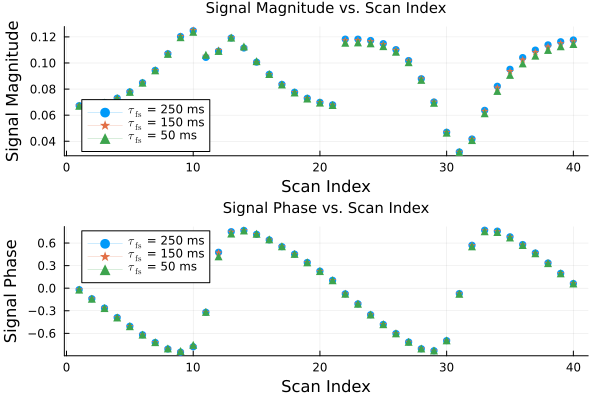
prompt()Cramer-Rao Bound
for the designed scan
kappa = 1 # also estimate the B1+ factor
M0_phase = π/3 # just to make it non-trivial
xt = (; M0_phase, Mz0, f_f, T1_f_ms, T1_s_ms, T2_f_ms, T2_s_ms, τ_fs, Δf_myelin_Hz,
    Δf_Hz, kappa) # unknowns in tuple, including both ΔB0 and B1 effects
x = collect(Float64, xt) # unknowns in vector
signal_c = (x) -> bssfp.(x[1:10]..., # Δf_Hz,
    deg2rad.(design.Δϕ_deg), TR_ms, TE_ms, #= kappa: =# x[end]*deg2rad.(design.α_deg))
signal_ri(x) = real_imag(signal_c(x));
Noise level
dB = 50 # SNR
σ = snr2sigma(dB, signal_c(x))0.00029672362537633545snr_check = 20*log10(norm(signal_c(x) / σ / sqrt(length(signal_c(x)))))
@assert snr_check ≈ dBCRB, standard deviation, and coefficient of variation
crb_ri = crb(signal_ri, x, σ)
crb_std = sqrt.(diag(crb_ri))
round2(x) = round(x; sigdigits=2)
crb_cv2 = round2.(crb_std ./ x)
tab2 = [ # table of results
 :dB dB :σ round2(σ);
 :TR_ms TR_ms :TE_ms TE_ms;
 :num_scans num_scans "" "";
 :param :value :std :crb_cv;
 collect(keys(xt)) collect(xt) round2.(crb_std) crb_cv2;
]
15×4 Matrix{Any}:
:dB 50 :σ 0.0003
:TR_ms 20 :TE_ms 4
:num_scans 40 "" ""
:param :value :std :crb_cv
:M0_phase 1.0472 0.0006 0.00057
:Mz0 0.77 0.038 0.049
:f_f 0.15 0.0084 0.056
:T1_f_ms 400 36.0 0.09
:T1_s_ms 832 86.0 0.1
:T2_f_ms 20 0.5 0.025
:T2_s_ms 80 1.1 0.014
:τ_fs 100.0 7.9 0.079
:Δf_myelin_Hz 5.0 0.31 0.063
:Δf_Hz 0.0 0.014 Inf
:kappa 1 0.049 0.049This page was generated using Literate.jl.